


 Return
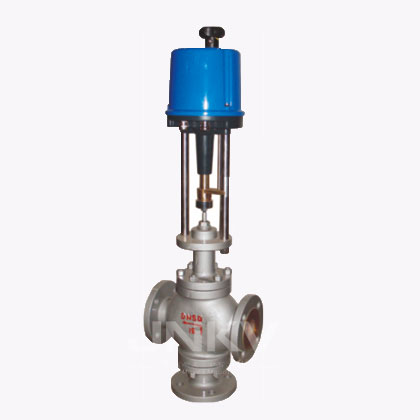

Electric Three-Way Control Valve
Product Model: ZDLX/ZDLQ
Body Material: WCB, 304, 316, 316L
Plug Material: WCB, 304, 316, 316L
Seat Material: 304, 316, 316L + STL
Seat Type: Single-seat, Double-seat, Cage-guided
Connection Type: Flanged, Threaded, Welded
Three-way Structure: Three-way diverging, Three-way converging
Electric Actuator: Intelligent regulating type, On-off type
Voltage: AC380V, AC220V, DC24V, etc.
Product Overview
The electric three-way control valve is composed of a linear-stroke electronic electric actuator and a three-way converging (diverging) valve with a cylindrical thin-wall window-shaped plug. It features a compact structure, light weight, sensitive action, and precise flow characteristics. It can directly accept control signals (4-20mA DC, 0-10mA DC, or 1-5V DC) and single-phase power to control operation, realizing automatic regulation and control of fluid media in process pipelines. It is widely used to precisely control process parameters such as pressure, flow, temperature, and liquid level of gases, liquids, steam, etc., keeping them at given values. It is suitable for working conditions where one fluid is divided into two flows through a three-way valve, or two fluids are merged into one through a three-way valve.Classification and Structural Features
Electric three-way control valves are divided into converging valves and diverging valves according to the fluid action mode. A converging valve has two inlets and the fluid flows out from one outlet after merging. A diverging valve has one fluid inlet and divides it into two fluids flowing out from two outlets. The structure of a converging three-way control valve is similar to that of a diverging three-way control valve. Its features are as follows:-
The electric three-way control valve has two plugs and seats, similar to a double-seat valve. However, in a three-way valve, when the flow area between one plug and seat increases, the flow area between the other plug and seat decreases. In a double-seat valve, the flow areas between both plugs and seats increase or decrease simultaneously.
-
The air-to-open and air-to-close of an electric three-way control valve can only be achieved by selecting the direct or reverse action of the actuator. The air-to-open and air-to-close of a double-seat valve can be changed directly by reversing the installation of the valve body or the plug and seat.
-
When used in a control system requiring fluid proportioning, the three-way valve replaces one air-to-open control valve and one air-to-close control valve, thereby reducing costs and installation space.
-
It is also used in bypass control applications. For example, one fluid passes through a heat exchanger for heat exchange, while the other fluid does not. When the three-way valve is placed before the heat exchanger, a diverging three-way valve is used; when installed after the heat exchanger, a converging three-way valve is used. Because the fluids flowing through the three-way valve installed before the heat exchanger have the same temperature, the leakage is relatively small; the fluids flowing through the three-way valve installed after the heat exchanger have different temperatures, resulting in different expansion degrees of the plug and seat, and therefore larger leakage. Usually, the temperature difference between the two fluids should not exceed 150°C.
Three-way valves adopting a cage structure have balancing holes and use cage guiding, which greatly reduces the unbalanced force. Early three-way valves used cylindrical thin-wall windows with plug side guiding. Although this reduced the unbalanced force, there was still a large unbalanced force when one fluid approached closure (flow-to-close direction), and the unbalanced force varied with the valve opening. The cage structure with balancing holes eliminates the unbalanced force and provides a damping effect, which is conducive to the stable operation of the control valve.
Due to the relatively large leakage of electric three-way control valves, in applications requiring low leakage, two control valves (with two-way connections) can be used for fluid diverting, converging, or proportioning control.
Valve Body
-
Type: Three-way cast structure
-
Nominal Diameter: DN20–DN200
-
Nominal Pressure: ANSI 150, 300, 600LB / JIS 10, 16, 20, 30, 40K / PN1.6, 2.5, 4.0, 6.4 MPa
-
Connection Type: Flanged: FF, RF, RJ, and LG
-
Flange Standard: ANSI B16.5, JIS B2201 / JB/T 79.1 PN1.6MPa, JB/T 79.2
-
Threaded: DIN, NPT, RC, BSP, G, etc.
-
Welded: GB 12224-89
-
Sealing Face Type: PN16 raised face (RF), PN40 recessed face (FM)
-
Material: WCB, 304, 316, 316L
-
Bonnet: Standard type (-20°C to +200°C), Cryogenic type (-60°C to -196°C), Finned type (-40°C to 450°C), Bellows seal type.
-
Gland Type: Clamp plate type
-
Packing: V-type PTFE, flexible graphite
Valve Internals
-
Plug Type: Single-seat plunger type
-
Plug & Seat: 304, 316 + STL (Stellite)
-
Flow Characteristic: Equal percentage, linear, quick opening
Actuator
-
Type: Electric actuator
-
Action: Direct action, Reverse action
-
Control Mode: Proportional regulating type or On-off type
-
Input Signal: 4-20mA, 0-10V, 1-5V, ON-OFF
-
Output Signal: 4-20mA or dry contact signal
-
Power Supply: AC220V, AC380V, DC24V, etc.
-
Explosion-proof Rating: ExdIIBT4, ExdIICT6, or others (optional)
-
Manual Device: With handwheel
-
Accessories (Optional): Heater, Overload protection
Product Performance
-
Rated Kv Value: Refer to table
-
Flow Characteristic: Linear, equal percentage, quick opening
-
Adjustable Range (Rangeability): 30:1
-
Leakage Class: Metal seal: <0.01 (ANSI B16.104-1976 Class IV); Soft seal: <0.00001%
-
Hysteresis: <1% of full stroke (with positioner); <3%-5% of full stroke (without positioner)
-
Basic Error: <±1% of full stroke (with positioner); <±5% of full stroke (without positioner)
-

