


 Return
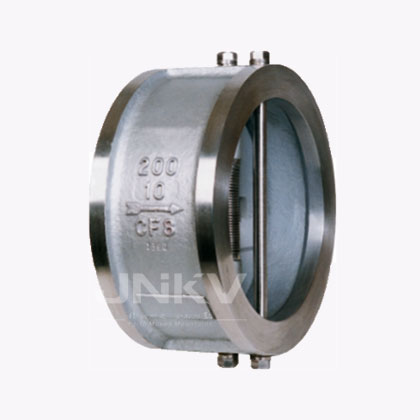

Wafer Check Valve
Product Model: H76H/W
Nominal Diameter: NPS 2"–NPS 60" / DN50–DN1500
Pressure Range: CL150–CL600 / PN10–PN100
Working Temperature: -29°C to +425°C
Main Material: Carbon steel, Stainless steel, Alloy steel
Application: Suitable for pipelines handling media such as tap water, food, pharmaceuticals, power, petroleum, liquefied gas, steam, etc.
Product Overview
The wafer check valve is also known as a reverse flow valve, non-return valve, back-pressure valve, or one-way valve. This type of valve opens and closes automatically by the force generated by the flow of the medium itself in the pipeline, belonging to the category of automatic valves.Design Specifications
-
Design Standard: API 6D, JB/T 8937, API 594
-
Face-to-Face Dimensions: API 594, JB/T 8937
-
Connection Standard: ASME B16.5, GB/T 9113, JB/T 79, HG/T 20592
-
Pressure Test: API 598, GB/T 13927, JB/T 9092
-
Pressure-Temperature Rating: ASME B16.34, GB/T 12224
Product Features
-
Short face-to-face dimensions, small size, and light weight.
-
The sealing disc can be made of soft-sealing or hard-sealing materials according to different working conditions, providing good sealing performance.
-
Can be used in both horizontal and vertical pipelines, making installation convenient.
-
Fast disc closing, resulting in low water hammer pressure.
-
The part materials, valve end types, and dimensions can be reasonably selected according to actual working conditions or user requirements to meet various engineering needs.
Working Principle
The purpose of this type of valve is to allow the medium to flow in only one direction and prevent reverse flow. Usually, this valve works automatically: under the pressure of fluid flowing in one direction, the disc opens; when the fluid flows in the reverse direction, the fluid pressure and the disc's own weight close the disc against the seat, cutting off the flow. The stainless steel wafer check valve belongs to this type, which includes swing check valves and lift check valves. The swing check valve has a hinge mechanism and a door-like disc resting freely on an inclined seat surface. To ensure the disc reaches the proper position on the seat each time, the disc is designed on a hinge mechanism, giving it sufficient swing space for true, comprehensive contact with the seat. The disc can be made entirely of metal, or metal inlaid with leather, rubber, or synthetic coverings, depending on performance requirements. When fully open, fluid pressure is almost unobstructed, so the pressure drop across the valve is relatively small. The lift check valve's disc rests on the seat sealing surface on the body. Except that the disc can freely lift and lower, the rest is like a globe valve: fluid pressure lifts the disc from the seat sealing surface, and reverse flow causes the disc to fall back onto the seat, cutting off flow. Depending on conditions, the disc can be all-metal or have a rubber pad/ring inlaid on the disc holder. Like a globe valve, the passage through the lift check valve is narrow, so the pressure drop is larger than a swing check valve, and the flow of a swing check valve is rarely restricted.Working Characteristics
The working characteristics of check valves are large load variations, low opening/closing frequency; once in a closed or open state, the duty cycle is very long, and no movement of moving parts is required. But once a "switching" demand arises, they must act flexibly—a requirement more stringent than common mechanical motion. Since check valves in most practical use are qualitatively determined for fast closing, at the moment of closing, the medium is flowing in the reverse direction. As the disc closes, the reverse flow velocity drops from maximum to zero rapidly, while pressure rises rapidly, producing a "water hammer" phenomenon potentially damaging to the pipeline system. For high-pressure systems with multiple pumps in parallel, the water hammer problem is more prominent. Water hammer is a pressure wave in transient flow in pressure pipelines, a hydraulic impact phenomenon of pressure rise or drop caused by changes in fluid velocity. Its physical cause is the combined effect of fluid incompressibility, fluid motion inertia, and pipe elasticity. To prevent water hammer hazards, over the years, new structures and materials have been adopted in check valve design, achieving gratifying progress in minimizing water hammer impact while ensuring performance. A check valve refers to a valve that relies on the medium's own flow to automatically open and close the disc to prevent backflow, also known as a non-return valve, one-way valve, reverse flow valve, or back-pressure valve. A check valve is an automatic valve whose main functions are to prevent backflow, prevent pump and motor reverse rotation, and discharge container media. It can also be used in pipelines supplying auxiliary systems whose pressure may rise above the main system pressure. Check valves are mainly divided into swing check valves (rotating by center of gravity) and lift check valves (moving along the axis).Product Applications
Check valves are used in pipeline systems. Their main functions are to prevent medium backflow, prevent pump and drive motor reverse rotation, and discharge media from containers. Check valves can also be used in pipelines supplying auxiliary systems whose pressure may rise above the main system pressure. Depending on the material, check valves can be applied to pipelines with various media. When installed in a pipeline, the check valve becomes one of the fluid components of the complete pipeline. Its disc opening/closing process is affected by the transient flow state of the system it is in; conversely, the closing characteristics of the disc also have a reaction on the fluid flow state.-

